Food: Identity and Design
Elective Course Taught at Mariam Dawood School of Visual Arts & Design Beaconhouse National University as a part of the Interdisciplinary Expanded Design and Art
Spring 2025
Course Instructor: Laiba Aslam
Teaching Associate: Ahmed Umer
Course Description
This interdisciplinary course places food at its core, exploring it as a medium of creative expression, a site of personal and cultural identity, and a catalyst for connection. Through the lens of semiotics and phenomenology, students examine food’s symbolic, political, emotional and mnemonic dimensions in art and design. The course focuses on reimagining food’s role in the contemporary society focusing on cultural and traditional food practices, sensory experiences, gender roles, sustainability and food security. Through creative articulation and critique, students explore how food design can challenge norms, provoke thoughtful discussions, and inspire innovative solutions for contemporary issues.
Projects

Reimagining Food in Art & Design
In this project, students explored the intersection of food with art and design by selecting and analyzing a seminal work in the field. They researched its historical, cultural, and material context, then reimagined the piece for today’s world—responding to contemporary environmental, societal, and technological shifts. The final outcome included a written analysis and a visual reinterpretation presented as a sketch, model, or digital rendering through AI.

Cooking up the Past!
Students translated a meaningful memory or life experience into a recipe, using food as a storytelling tool through the help of semiotics. They reflected on a personal event and created a dish inspired by it. Each recipe included a list of ingredients, with quantities and preparation methods, along with an analysis of each ingredient’s emotional, cultural, or symbolic significance. Cooking instructions were written creatively, often as narratives. Students prepared their dishes and brought their cooked memories to class, sharing the deeper meanings behind each bite.
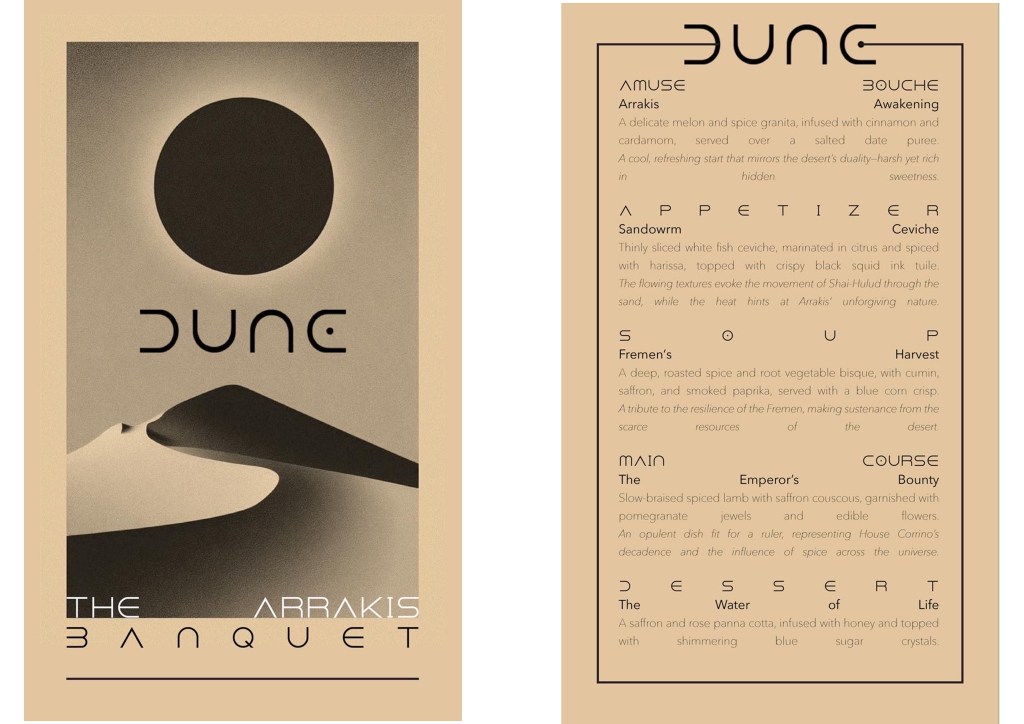
In this assignment, students designed a five-course menu inspired by a film of their choice, using food as a storytelling medium. Each course—Amuse-Bouche, Appetiser, Main Course, Dessert, and After-Dinner Drink—symbolically represented a character, theme, or pivotal moment from the film. Students selected emotionally or thematically rich films and translated their essence into thoughtfully conceptualized dishes. Brief written explanations accompanied each course, highlighting its narrative connection. The final menu was visually presented in a format that aligned with the film’s aesthetic, blending culinary creativity with cinematic analysis.

Personal and Cultural Identity
In this assignment, students worked in pairs to explore cultural, personal, and social identities through conversations about food. Each pair interviewed one another, discussing family rituals, food memories, cultural traditions, migration, gender roles, and dietary choices. They documented their findings and created a visual representation—such as an infographic, illustrated timeline, mind map, or collage—to convey their partner’s relationship with food. The visuals were then presented to the class, alongside reflections on the learning process, shared experiences, and meaningful connections formed through the dialogue.
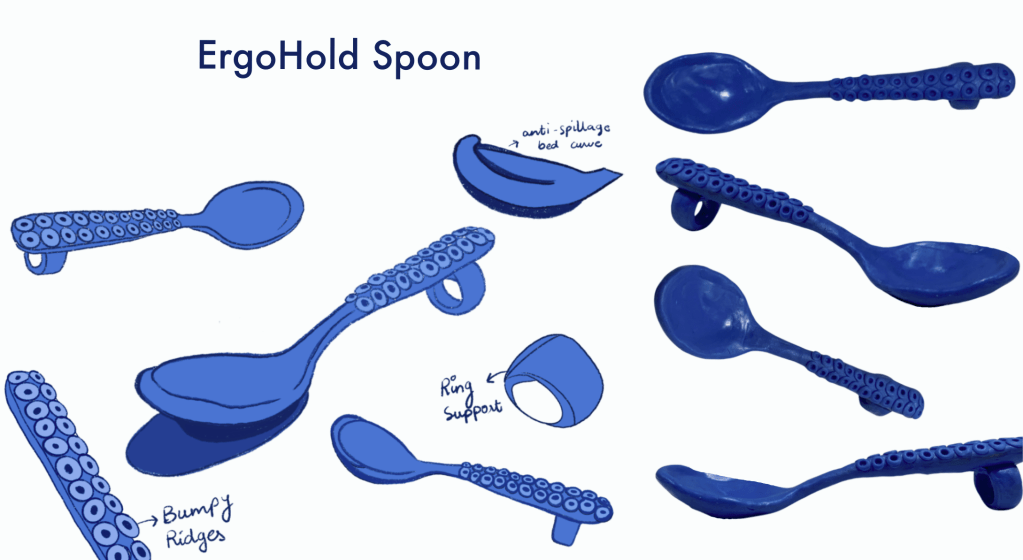
Gastrophysics; Reimagining Dining
In this assignment, students designed and created an innovative dining product; such as cutlery, crockery, or a utensil that enhances the eating experience through meaningful design. Informed by insights from gastrophysics, students explored how shape, texture, color, and form affect sensory and psychological perception during dining. Each student submitted a functional prototype along with a detailed process PDF including their concept statement, research, initial sketches, development process, and final design visuals. The project aimed to develop skills in ideation, prototyping, and presentation, with evaluation based on creativity, application of gastrophysics, craftsmanship, and overall presentation quality.

In this assignment, students learned about the role of communal dining in building connections in a community. After being introduced to various examples of artists and designers who use food as a social tool, students were divided into three groups. Each group was tasked with curating a communal dining experience that encouraged participation, dialogue, and care. The assignment culminated in three group-led projects that brought people together around food, highlighting the power of shared meals to create meaningful social interactions.

For this project, students created their own conceptual food manifestos inspired by the Futurist Cooking Manifesto(1932), which blended performance, science, aesthetics, and emotion. Each manifesto reflected the creator’s personal ideals, values, obsessions, and fantasies surrounding food, identity, and design, encouraging a perspective beyond nourishment. Students presented a performative declaration that included a title and statement of intent, ten poetic or political dining rules, and three imagined dining experiences, recipes, or rituals. Visuals, moodboards, and sound elements enhanced the presentations, which ranged in tone from surreal and humorous to tender, angry, or dystopian.

The final project, titled “Chef’s Special,” invited students to develop an independent, research-based work that reflected their personal interests and the themes explored throughout the course. Much like a chef crafting a signature dish through skill, experimentation, and personal touch, students were encouraged to pursue a concept that felt meaningful or urgent to them—whether connected to food and memory, identity, ritual, material culture, storytelling, or social critique.
 Laiba Aslam